Intimidation Tactics, Part 1
The targets are many and the implications are profound


It’s not surprising that the President who sent a raging mob to storm the Capitol in a vain and dangerous attempt to intimidate Congress into overturning the 2020 election results, has made intimidation the center piece of his second term. Many of Trump’s domestic policy actions since the inauguration are obvious intimidation attempts. His campaign to root out government employees is intended, among other things, to intimidate any employee left over after the purges.
The flurry of outrageous executive orders, sometimes referred to as a “shock and awe” campaign, are in aggregate intended to demoralize and intimidate domestic opposition and the public at large.
Now it seems that we have transitioned to Phase 2 and the risks have become more apparent. This post is part 1 of a 2 part series that will review some recent events in Trump’s intimidation campaign. This post will look at his latest efforts to quell domestic opposition; in part 2 we’ll look at the latest attempts to intimidate the rest of the world.
Domestically, a multi-pronged effort to intimidate the Judiciary is in progress, aided and abetted in one case by a GOP Congressmen. Given that the GOP Congress has completely abdicated its Article I powers and responsibilities, effectively eliminating Congress as a check on Trump’s actions, intimidating the Judiciary would be the final step in creating an autocratic presidency.
The attempt to intimidate the Federal Judiciary involves a lot of posturing and jawboning, and at least two overt actions so far. Some of it is familiar; any Judge who rules against the administration, and was nominated by a Democratic President, is routinely accused of being a partisan hack, “biased” against Trump and the GOP. We can call that one “Democratic nominee derangement syndrome.”
In January, there was a more concrete attempt to intimidate Federal Judges when Musk and his barely adult minions sent the infamous “fork in the road” email to Federal Judges. Allegedly this was a mistake.
A mistake? One might legitimately infer that the mistake was that Musk didn’t know that Federal Judges have lifetime appointments and cannot be fired by conventional means. Perhaps the mistake was mere sloppiness by his minions. Maybe someone “forgot” to tell the immature computer geeks to exclude Judges. Or perhaps the mistake was that they got caught. You be the judge.
Its probably a good thing that many of the Judges who have ruled against the Administration are Reagan or Bush nominees. In fact, it was a Reagan nominated Judge, Seattle-based district court Judge John Coughenour, who said:
“It has become ever more apparent that to our president the rule of law is but an impediment to his policy goals. The rule of law, according to him, is something to navigate around or simply ignore, whether that be for political or personal gain.
“Nevertheless, in this courtroom and under my watch, the rule of law is a bright beacon which I intend to follow,… I refuse to let that beacon go dark today.”
The Administration said nothing in public about this dressing down, though one can be certain they seethed over it. This is one of several rebukes of the Administration delivered by Republican appointed Judges. It turns out that Federal Judges are not pushovers and Republican Judges know something about the rule of law. Imagine that.
VP Vance has turned out to be the lead public voice for the intimidation strategy #2, the assertion that the administration can ignore court orders that it doesn’t like. This is a long running theme for Vance:
In 2021, he said “[W]hen the courts stop you, stand before the country like Andrew Jackson did and say, ‘The chief justice has made his ruling. Now let him enforce it.”
He reaffirmed his position last year in an interview with Politico and went on to expound:
“For me, this is not a limited-government thing — this is a democracy thing,” he continued when I prompted him to explain. “Like, you need the bureaucracy to be responsive to the elected branches of government. The counterargument is, you know, ‘Aren’t you promoting a constitutional crisis?’ And my response is no — I’m recognizing a constitutional crisis. If the elected president says, ‘I get to control the staff of my own government,’ and the Supreme Court steps in and says, ‘You’re not allowed to do that’ — like, that is the constitutional crisis. It’s not whatever Trump or whoever else does in response. When the Supreme Court tells the president he can’t control the government anymore, we need to be honest about what’s actually going on.”
On February 9, he wrote on X:
“If a judge tried to tell a general how to conduct a military operation, that would be illegal. If a judge tried to command the attorney general in how to use her discretion as a prosecutor, that’s also illegal. Judges aren’t allowed to control the executive’s legitimate power.” [Emphasis mine]
Lets unpack the February 9 post. The examples given are a diversion with no basis in fact. Judges don’t don’t tell generals how to conduct military operations. The second example is even more absurd in that it suggests that Judges might affirmatively tell the AG to exercise discretion in a particular way. That is not how things work.
The last sentence of the post inserts the weasel word “legitimate” into the phrase. Who decides whether an exercise of executive power is legitimate under the Constitution? Federal Judges and ultimately the Supreme Court, of course!
But he deliberately omits the term exercise, so Vance means something entirely different. The modifier “legitimate” is intended to reference Article II enumerated powers, and likely unenumerated but claimed powers. He thus erects a wall between powers and their exercise, suggesting that the Judiciary may not review the exercise of any power determined or claimed to exist.
How does that work? For example, the President is Commander in Chief of the military, and according to Vance’s theory, that power is not subject to constraint by the Courts and, by logical extension, Congress. So the Posse Comitatus Act of 1878, which constrains the use of the military for domestic law enforcement, would be unenforceable, if not null and void.
Trump later said the Administration would respect court orders. This is another diversion, lacking only the usual ritual lie that he has no idea who JD Vance is. Saying he’ll obey court orders is just a setup for down the road when, in the wake of an adverse ruling from SCOTUS, he will claim that the Supreme Court is the one creating a Constitutional Crisis. The White House Press Secretary is already calling jurists who rule against them “judicial activists.”
Need more evidence that’s where this is heading? Let’s repeat what JD Vance said to Politico:
If the elected president says, ‘I get to control the staff of my own government,’ and the Supreme Court steps in and says, ‘You’re not allowed to do that’ — like, that is the constitutional crisis. It’s not whatever Trump or whoever else does in response.
We’ve been fully warned.
We already have a ruling from U.S. District Court Judge John McConnell Jr. in Rhode Island that the administration is violating the Temporary Restraining Order telling Trump he can’t withhold appropriated funds. Based on the Impoundment Control Act of 1974, which was held constitutional by a unanimous Supreme Court, there is no doubt that the Judge’s TRO is sound. So here we have a proven case of ignoring a valid court order. Busted.
Cue intimidation strategy #3. When all else fails, attempt to impeach the Judge who ruled against you. The willing co-conspirator this time is Congressman Andrew Clyde (R-GA) who announced on X that he was drafting articles of impeachment.
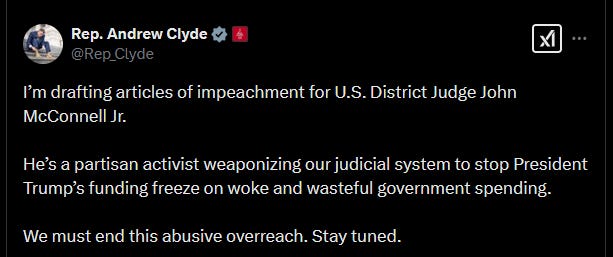
So now ruling against the administration is a high crime or treason? This is, of course, a purely performative act. There is no possibility that the Senate would convict. I’ll be curious to see if this actually gets passed by the House, though so far it seems that no performative act is too extreme to be ratified by the doltish GOP House of Representatives. The only purpose of the exercise, aside from tossing red meat to the Musky MAGA tribe, is to attempt to intimidate this and other Judges.
I’ve seen all sorts of debate as to whether we are in a Constitutional crisis. Congress’ abdication of its responsibilities, particularly the power of the purse, under Article I is a crisis unto itself. The Judiciary is our last Constitutional defense, and also the weakest branch of government because it has no hard power. The truth is obvious if you care to see it: Trump is intent on tearing both the government and our social fabric into pieces, and the consequences for our country are profound.
We seem to be a house divided, not unlike the period before the Civil War, where we are disagreeing about some of the most basic tenets of our democracy. We saw on January 6, 2021 that some are ready to use violence.
The silver lining may be that the administration’s “everything, everywhere, all at once” strategy may be backfiring already. In their zeal to enact Project 2025’s roadmap to authoritarianism, Trump and his co-conspirators have already inflicted pain on their own supporters in Middle America by cutting off USAID purchases of farm goods and Dept of Agriculture grants for farm infrastructure improvements. Planned cuts to Medicaid will hit those communities hard. Widespread layoffs of government employees will result in the breakdown of services that many farms, businesses and individuals rely on, as soon as next week.
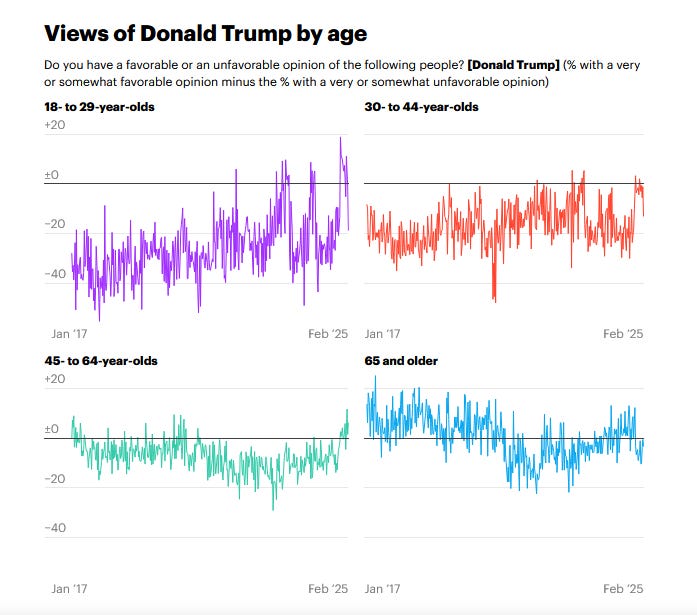
Polling and anecdotal evidence is starting to show buyer’s remorse, especially among the critical 18 to 29 year old group, many of whom voted for Trump largely because they were pissed off about how the pandemic messed with their lives and expectations, for which they decided to blame Democrats.
Congressional Republicans have been feeling some heat this week, and a few are timidly speaking out. Now that they are home for a 10 day stretch, some may find themselves beset with angry constituents. Democratic town halls and zoom calls are getting record attendance. Any Republican with the courage to face their constituents will likely see the same thing.
If budget negotiations among Republicans break down when they return to Congress, we’ll know the pressure building.
Unless and until things change dramatically, I don’t think we need to wait for the last domino to fall to declare a crisis. We’re in a full blown Constitutional crisis and, potentially, an incipient civil war. Get used to it and get ready to hit the streets. We’re probably in for a long, bitter fight.
Unfortunately, Trump’s intimidation strategy does not end at the border, and there is another aspect to this unfolding catastrophe. In the companion post to this one, Intimidation Tactics, Part 2, we’ll review the foreign affairs disaster in progress that will make things worse for us and the rest of the world.
Who’s afraid of the big bad wolf!